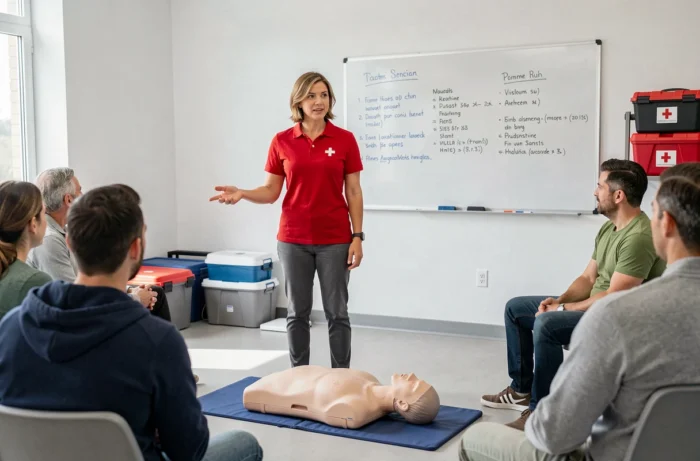
A first aid trainer is a certified professional who teaches first aid techniques to various audiences, relying on national educational frameworks. Becoming a first aid trainer requires validating several distinct certifications depending on the type of training aimed at (PSC1, SST, PSE) and committing to a continuous update of skills.
Regulatory prerequisites and certifications to become a first aid trainer
The path does not begin with trainer training. One must first hold the competency certificate corresponding to the level one wishes to teach. For the general public, the PSC1 (Level 1 Civic Prevention and First Aid) is the foundation. To intervene in a professional environment, the SST certificate (Workplace First Aid Rescuer) serves as the entry point.
The trainer certification is then prepared with an authorized organization. The INRS coordinates the SST pathway at the national level. The French Red Cross, the FFSS (French Federation of Lifesaving and First Aid), and other accredited civil security associations offer PSC and PSE trainer pathways.
Each pathway has its own prerequisites. For the SST trainer training, one must hold an up-to-date SST certificate and demonstrate skills in professional risk prevention. The PSE trainer training requires holding the PSE2 and operational practice within a rescue team. These conditions are not interchangeable: an SST trainer is not automatically qualified to teach PSC1, and vice versa.
Detailed information on certification pathways is available on the Soutien Adom website for trainers, which outlines the steps by pathway.
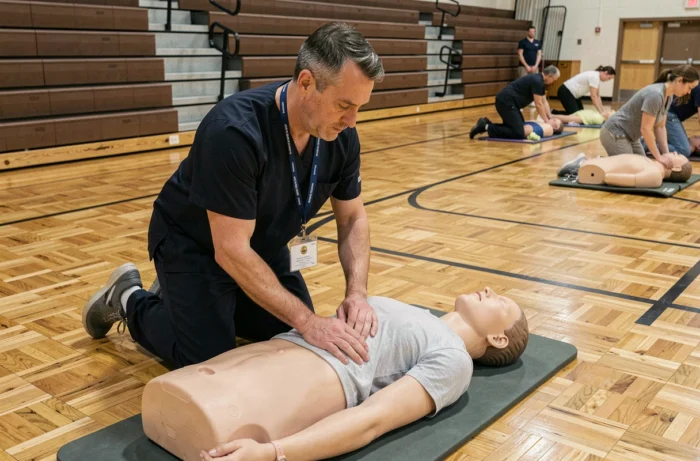
SST, PSC, and PSE pathways: choosing your trainer specialization
The choice of pathway depends on the target audience and the exercise framework. These three specializations do not address the same structures or learners.
- SST trainer: intervenes in companies to train employees in workplace first aid. The SST trainer incorporates a dimension of professional risk prevention absent in the other pathways. They often work within a training organization or as an internal company trainer.
- PSC trainer: teaches first aid techniques to the general public in an associative or institutional framework. PSC1 is the most widespread civic training in France.
- PSE trainer: trains rescue team members (PSE1 and PSE2) who intervene during planned rescue operations or in accredited civil security associations. The technical requirements are the highest among the three pathways.
A trainer can accumulate several certifications throughout their career. Starting with the SST pathway offers quick access to the continuing professional training market, where demand is strong.
Maintaining trainer skills: an often underestimated obligation
Obtaining the initial certification is not enough for sustainable practice. Maintaining and updating skills is mandatory to retain one’s qualification. A trainer who does not attend these sessions within the required time loses their right to teach.
The INRS provides in its 2027 catalog specific training sessions for maintaining and updating skills for SST trainers. These sessions incorporate regulatory changes, field experience feedback, and pedagogical adjustments.
Regulatory monitoring is part of the trainer’s daily routine. Competency frameworks evolve, care techniques are updated, and employer obligations regarding workplace safety are strengthened. A trainer who does not practice regularly loses technical and pedagogical credibility.
Sector-specific specializations: risk prevention and new opportunities
The profession of first aid trainer is no longer limited to traditional first aid sessions. The INRS 2027 catalog illustrates this evolution: pathways now target sectors such as road transport, logistics, or psychosocial risk prevention.
Psychosocial risk prevention is a development focus for trainers looking to broaden their intervention scope. The boundary between physical first aid and mental health support is narrowing, with the emergence of programs like Mental Health First Aid (PSSM).
For an independent trainer, these specializations represent a differentiation lever. Companies seek trainers capable of covering both traditional first aid and the prevention of risks specific to their sector. Combining an SST certification with expertise in sector-specific prevention opens doors that general training alone cannot reach.
Professional status and affiliation with a training organization
Working as a first aid trainer requires choosing a legal framework. There are two main options: employment within a training organization or an accredited association, and working independently.
The independent trainer must obtain an activity declaration number from the prefecture and comply with the administrative obligations related to continuing professional training. They must also be affiliated with an authorized entity to issue official certifications, as a trainer alone cannot issue an SST or PSC1 certificate without this backing.
The choice between these statuses depends on the desired volume of activity and the level of autonomy sought. Employment offers stability and a regular flow of sessions. Independence allows for diversifying clients and sectors but requires commercial and administrative management that the employee status does not.
The initial certification, the choice of pathway, the maintenance of skills, and the legal status form the four concrete pillars of the journey. Each one conditions the next, and neglecting any of them directly limits the ability to practice.