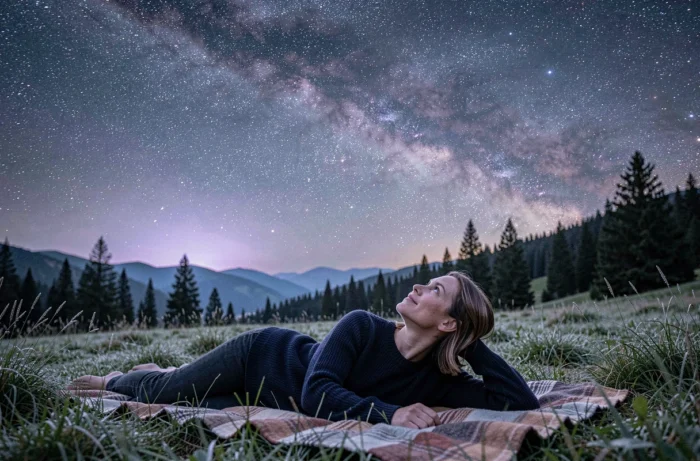
Looking up on a clear night remains one of the simplest gestures to touch the vastness. Yet, exploring the wonders of the universe is no longer just about pointing a telescope at the Moon. With new space missions, scientific data accessible to everyone, and an increasingly crowded sky, preparing for an extraordinary journey under the stars requires understanding what has changed up there.
Light Pollution and Mega-constellations of Satellites: A Closing Sky
Have you noticed that the stars seem fewer than they did ten years ago? It’s not just an impression. The International Telecommunication Union (ITU) describes a real paradigm shift: mega-constellations of satellites are now disrupting the entire visible sky.
In the past, astronomers had to deal with a few point emitters. Today, massive and variable groups cross the field of view of telescopes and amateur observers. This issue affects not only scientists. Anyone traveling to observe the sky, whether in the Atacama Desert or the Cévennes, notices these light trails in their photos.
Radio interference poses another concern. The frequencies used by these constellations sometimes overlap with those utilized by radio telescopes. For anyone wishing to organize an astronomical observation trip, several online resources can help identify the least light-polluted sites, such as voyage-univers.com, which lists destinations suitable for observing the night sky.

Roman Space Telescope: Open Data Changing Amateur Astronomy
The Nancy Grace Roman Space Telescope is not just a simple successor to the James Webb Telescope. Roman is designed to map vast portions of the sky, where Webb focuses on specific targets.
What changes the game for enthusiasts is the data dissemination model. Roman’s image streams will be accessible to the public almost in real-time. In practical terms, an amateur astronomer or a teacher will be able to use the same data as a CNRS researcher, just a few hours after it is captured.
Why Open Data Matters for Your Next Trip
This principle of open data transforms how to prepare for an observation outing. Before heading out under a starry sky, one can now:
- Consult catalogs of celestial objects updated by ongoing missions to target galaxies or nebulae visible from their geographical location
- Download high-resolution images to compare what they see in their telescope with professional data
- Follow discoveries live (exoplanets, supernovae) and direct their instrument towards recent events
Astronomy is no longer reserved for laboratories. This democratization also means that astronomical travel takes on a new educational dimension, whether with family or among enthusiasts.
Choosing Your Observation Destination: Concrete Criteria and Pitfalls to Avoid
A journey under the stars is not improvised like a beach weekend. The choice of site relies on technical parameters that many guides overlook.
The Quality of the Sky Depends Not Just on Urban Distance
Traveling far from a city does not guarantee anything if the chosen site is under a path of geostationary satellites or in an area of high atmospheric humidity. Altitude, air dryness, and the absence of satellite corridors are three criteria that matter as much as the distance from urban lights.
The high desert plateaus remain the best candidates. However, in Europe, some mid-mountain areas offer remarkable conditions, provided that the average cloud cover during the stay is checked.
Adapting Your Equipment to Local Regulatory Constraints
Some observation sites are located in natural reserves or protected areas. Setting up a motorized telescope with electrical power may require permission. International dark sky reserves, a label awarded to territories that actively limit light pollution, sometimes impose restrictions on personal lighting.
Before leaving, it is advisable to contact the local authority or site manager. A good observation spot is also a site where you are allowed to observe.
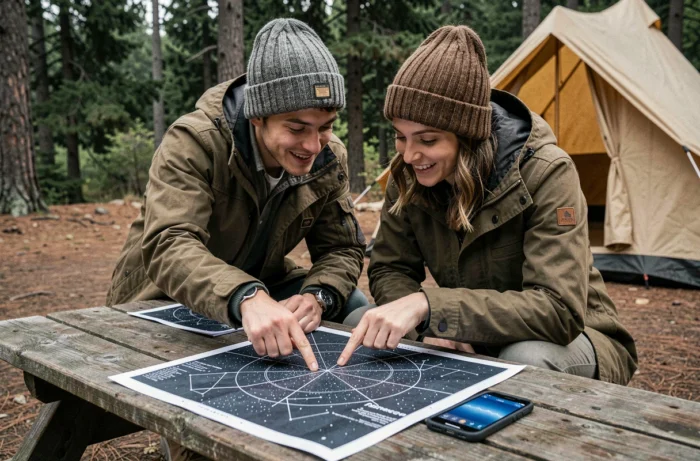
Sharing the Experience of the Night Sky with Family
Observing stars with children works best when you abandon the idea of sophisticated equipment. A pair of classic binoculars is enough to spot lunar craters, Jupiter’s moons, or the Milky Way’s milky band.
The real educational lever is the storytelling. Explaining why the light from a star has traveled for years before reaching our eyes provides a scale that children intuitively grasp. Every photon captured is a message from the past, and this idea often suffices to captivate an audience of all ages.
- Prefer moonless nights to observe the Milky Way, consulting a lunar calendar before departure
- Download a sky map application that works offline, useful in areas without mobile network
- Prepare warm clothing even in summer, as observation nights at altitude can cause temperatures to drop quickly
The world of astronomy is going through a paradoxical period. The sky has never been so well-mapped, thanks to missions like Roman, and data has never been so accessible. But physical access to the night sky is becoming more complicated due to satellite constellations and increasing light pollution. Preparing an observation trip today means combining scientific curiosity with practical vigilance about the actual conditions of the chosen site.