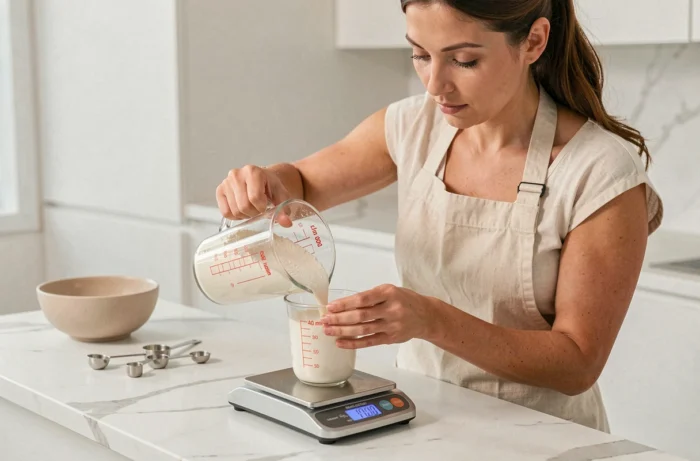
In cooking, 400 ml of water weighs 400 g. This simple equivalence leads many people to apply the same rule to every ingredient, throwing off measurements as soon as they move beyond water-based liquids. The actual weight of 400 ml depends on the density of each product: flour, honey, oil and sugar take up the same volume but do not weigh the same. Depending on the ingredient, the difference can amount to several hundred grams.
Measuring flour: why 400 ml never has a fixed weight
Flour is the most misleading example. With an average density often estimated at around 0.53 g/ml, 400 ml of flour weighs about 212 g. But that figure obscures a reality that conversion charts rarely address.
How you fill the measuring cup changes the weight for the same volume. King Arthur Baking recommends aerating the flour, spooning it into the measuring cup, then leveling it off with a knife. If you dip the cup directly into the bag, the flour gets packed down and the amount you scoop up increases noticeably. For the same 400 ml container, the difference in weight between these two methods can affect the texture of a batter or dough.
Sifting adds another variable. A recipe calling for “400 ml sifted flour” does not mean the same weight as one calling for “400 ml flour.” Sifted flour is more aerated, so it weighs less per unit of volume. If a recipe gives precise measurements in grams, it is better to follow those rather than convert a volume using a generic density.
So, to understand what 400 ml corresponds to in grams for each ingredient, you need to look beyond simple multiplication and consider the measuring method itself.
Density of common ingredients: conversion chart for 400 ml
The principle is the same for every ingredient: grams = milliliters multiplied by density. The values below use common average densities, but each product may vary slightly depending on its brand or temperature.
| Ingredient | Density (g/ml) | 400 ml in grams |
|---|---|---|
| Water | 1 | 400 g |
| Milk | 1.03 | ≈ 412 g |
| Honey | 1.38 | ≈ 552 g |
| Oil | 0.92 | ≈ 368 g |
| Granulated sugar | 0.9 | ≈ 360 g |
| Flour | 0.53 | ≈ 212 g |
| Melted butter | 0.91 | ≈ 364 g |
Honey and flour illustrate the two extremes. 400 ml of honey weighs about 552 g, more than twice as much as 400 ml of flour. Confusing these two ranges can transform a recipe.
Liquids with a density close to water
Whole milk, stock and vinegar have densities very close to 1. For these ingredients, treating 400 ml as roughly 400 g is an acceptable approximation in everyday cooking. The difference rarely exceeds 10 g.
Fats and sugars
Oil is lighter than water: 400 ml of oil weighs about 368 g. Granulated sugar falls in a similar range. Melted butter, with a density of 0.91, weighs about the same. These differences of 30 to 40 g compared with water become significant in baking, where proportions affect rise and texture.
Measuring cups: volumes vary by country
When a recipe specifies “400 ml,” the volume seems unambiguous. Problems arise when the amount is given in cups, since this unit is not universal.
- The US cup holds about 237 ml. Two cups therefore do not equal exactly 400 ml, but rather 473 ml.
- The metric cup, used in Australia in particular, holds 250 ml. Two metric cups equal 500 ml.
- The imperial cup, still found in some older British recipes, holds about 284 ml.
- For this specific purpose, US nutrition labeling regulations define a cup as 240 ml, a tablespoon as 15 ml and a teaspoon as 5 ml. These are regulatory conventions, not weight equivalents.
The same number of cups can represent very different volumes depending on which standard is used. If you are following an Anglo-American recipe that calls for “just under two cups,” checking which cup measurement it uses can prevent a difference of several dozen milliliters—and therefore several dozen grams once converted.

Kitchen scale or volume measurement: when conversion reaches its limits
Density charts show averages. Two brands of flour, two types of honey (liquid or crystallized) or two different oils (olive or sunflower) do not have exactly the same density. Reference charts do not always give the same weight for the same volume, depending on the source and the measuring method used.
For uniform liquids such as water, milk or vinegar, volume conversion remains reliable. The differences are negligible and do not affect the result of a recipe.
For powders (flour, cocoa, powdered sugar) and viscous products (honey, molasses, heavy cream), the situation is different. How you fill the container, the ingredient’s state (sifted or not, crystallized or liquid) and its temperature all affect the resulting weight. When a baking recipe gives quantities in grams, those measurements reflect the author’s exact method. Converting a volume using an average density does not guarantee the same result.
A kitchen scale, even a basic one, eliminates these variables. It measures mass directly without relying on an estimated density. For everyday recipes (soups, sauces, stews), volume conversion is sufficient. For baking or any preparation where precision determines success, weighing the ingredient remains the most reliable method.