Your water leaves white marks on the fixtures, you have installed a softener, and for a few months everything seems to be working. But a water softener is not a device that you plug in and forget about. Its maintenance determines the quality of the water produced, the lifespan of the resin, and the proper functioning of the regeneration valve.
Adjust the control of your softener to the actual use of the home
Most maintenance guides provide a fixed schedule: check the salt every month, disinfect once a year. This rhythm is suitable for a household that is occupied continuously, with stable water consumption. As soon as the usage changes, this schedule is no longer sufficient.
Are you going on vacation for several weeks? Water stagnates in the resin tank. Without circulation, bacteria can develop in the resin bed. Upon return, a manual regeneration is necessary before consuming the water. This is a reflex that few manuals mention, but it prevents health problems.
Conversely, a period of high consumption (renovations, hosting several people) accelerates the saturation of the resin. If the valve is programmed on a fixed cycle, it does not compensate for this increase. Monitor the hardness at the output after each change in usage, using a simple strip TH test.
Another common case: a move to a neighboring municipality, or a change in the water supply source by the water distributor. The hardness of the incoming water can vary, sometimes significantly. If your softener remains set to the old value, it either under-treats or over-treats the water. In both cases, the resin wears out faster. The good troubleshooting and maintenance reflexes adapted to these situations are detailed on the AKOITIQUE website, which covers these concrete scenarios.
Maintenance of the salt tank and resin: what really changes the lifespan
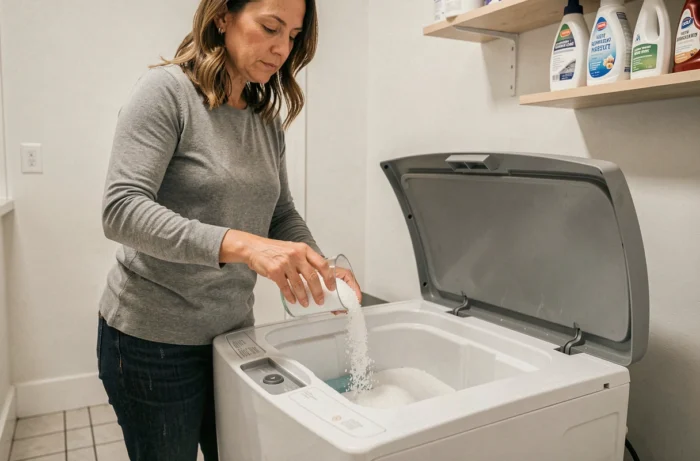
Regeneration salt is the main consumable of a softener. Regularly checking its level remains fundamental. But the quality of the salt is just as important as the quantity.
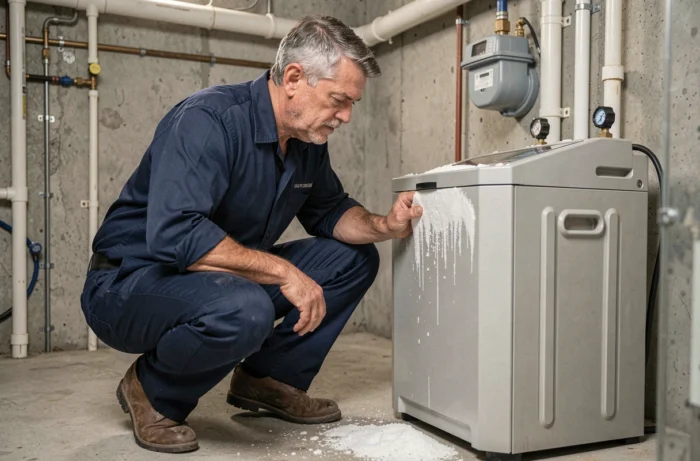
Low-quality salt leaves deposits in the brine tank. These residues form a compact crust, sometimes called a “salt bridge,” which prevents dissolution. The level appears correct visually, but the brine no longer forms. The resin is then not regenerated properly.
To avoid this trap, prefer high-purity pellet or tablet salt, sold specifically for softeners. Cleaning the salt tank once or twice a year remains a simple gesture that prevents clogging.
When should you clean or replace the resin?
The ion exchange resin has a lifespan that depends on the hardness of the treated water and the volume consumed. A household with very hard water puts more strain on the resin beads than a home supplied with moderately hard water.
Two concrete signs indicate a resin problem:
- The hardness at the output of the softener gradually increases, even after a complete regeneration, indicating a loss of exchange capacity
- The treated water takes on an unusual taste or odor, often linked to bacterial contamination of the resin bed
- Fine resin particles appear in the filtered water, a sign of mechanical degradation of the beads
A specific resin cleaner (regenerator) can extend its lifespan by eliminating iron or organic matter deposits. This cleaning does not replace a complete replacement when the resin is at the end of its life.
Regeneration valve and pre-filter: the two components not to neglect
The regeneration valve controls the entire cycle of the softener. It triggers the suction of brine, rinsing, and recommissioning. A malfunction of this valve often goes unnoticed, as the device continues to distribute water, but without treating it.
Checking the hardness at the output remains the most reliable way to detect a valve failure. If the hardness rises while the salt is present in sufficient quantity and the resin is in good condition, the valve is likely to be the cause.
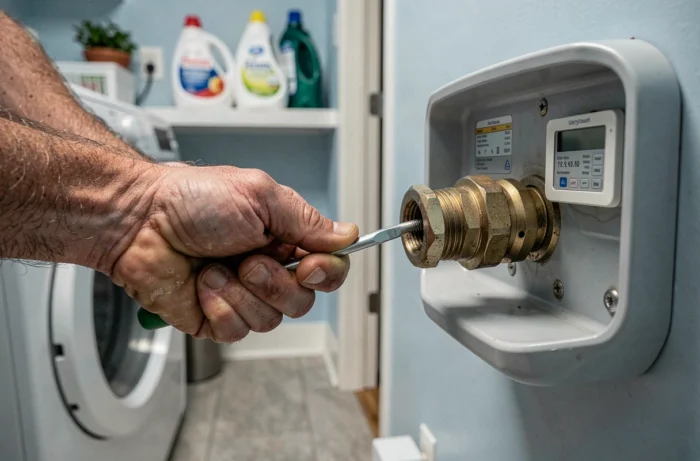
The internal seals of the valve wear out over time. On some models, seal kits are available and allow for repair without complete replacement. This type of intervention requires a minimum of technical skill: you need to cut off the water supply, depressurize the circuit, and disassemble the valve block.
The pre-filter, a often forgotten component
Most installations include a sediment pre-filter upstream of the softener. Its cartridge retains particles (sand, rust, debris) that can damage the resin.
A clogged pre-filter cartridge reduces flow and strains the device. Its replacement depends on the quality of the incoming water. In an area where the network carries particles, replacement may be necessary every few months.
When to isolate the softener and call a professional
Some symptoms justify putting the device in bypass (isolated position) and calling a qualified technician:
- A leak at the valve or connections, even minor, which may indicate a faulty seal or a crack in the valve body
- A regeneration that no longer triggers at all, despite correct programming and functional power supply
- Treated water whose hardness remains high after checking the salt, resin, and valve
- An abnormal noise during the regeneration cycle, often related to an internal mechanical problem
The bypass allows you to continue using network water (non-softened) during the intervention, without cutting off the supply to the home. Most softeners have an integrated bypass valve or an adaptable kit.
A maintenance contract with a professional may make sense for households that do not wish to handle the valve themselves or test the hardness. This type of contract generally includes annual checks of the resin, cleaning of the tank, and inspection of wear parts.
Maintaining a water softener is not just about filling the salt tank. Adjusting the frequency of checks to your actual consumption, monitoring the hardness at the output after each change in usage, and replacing wear parts at the right time protects both your device and the quality of your water.