The quality of a second-hand garment cannot be judged by a Vinted profile photo. It is assessed through the density of the fabric, the consistency of the seams, and the type of fibers indicated on the composition label. Buying second-hand clothes methodically requires mastering a few technical points that usual guides tend to overlook.
Textile composition and weight: the two criteria that filter above all else
A visually good second-hand garment can turn out disappointing to wear if the material is poor. The composition label remains the first reliable filter.
Items with more than half synthetic fibers (polyester, acrylic) pill faster and retain odors after a few washes. In contrast, an item made of dense cotton, merino wool, or linen maintains its shape over time, even after several owners. Favoring natural fibers reduces the risk of disappointment when wearing.
The weight, rarely mentioned on the label but perceptible to the touch, gives a direct indication of the remaining longevity. A t-shirt whose fabric lets light through has already lost most of its structure. A thick jersey, opaque when stretched in front of a light source, still has some margin. This test takes two seconds in a thrift store and can be done online by asking the seller for a photo of the stretched fabric.
To delve deeper into selection criteria and common pitfalls, you can discover Ei Mag online on the subject.
Legal warranty and right of withdrawal on second-hand clothes online
The seller’s status radically changes the protection you have. When a second-hand garment is sold by a professional, the legal conformity guarantee applies, even on a second-hand item. In case of an undisclosed defect in the listing, recourse exists.
For a remote purchase from a professional, the right of withdrawal is added to this guarantee. In a sale between individuals, these protections disappear: the transaction relies on good faith and the published description.
Before finalizing an online purchase, checking whether the seller is a private individual or a professional is as crucial as examining the photos. On platforms, this information is usually found in the seller’s profile or the terms of sale. Buying from a pro offers a legal safety net absent between individuals.
Inspection of wear areas: collar, armholes, and closures
The defects of a worn garment concentrate on a few predictable areas. Knowing where to look speeds up sorting and avoids unpleasant surprises upon receipt.
- The collar and cuffs show the first signs of wear. A collar that is wrinkled or whose ribbing is loose cannot be recovered by washing. Check the remaining elasticity by gently stretching the fabric.
- The armholes and inseam undergo repeated friction. Look for areas where the fabric is thinning or starting to pill, a sign of advanced structural wear.
- Zippers, snap buttons, and eyelets must function smoothly. Replacing a zipper at a tailor often costs as much as the item itself second-hand.
- The side seams and assembly seams must be intact. A pulled thread on a topstitch can be fixed, but a loose assembly seam compromises the overall strength.
Online, request photos of these specific areas. A seller who refuses or delays providing them signals a potential problem.
Thrift stores, platforms, and garage sales: how each channel changes price and quality
Each second-hand sales channel imposes its own constraints. The purchase channel determines the quality-price ratio as much as the condition of the garment.
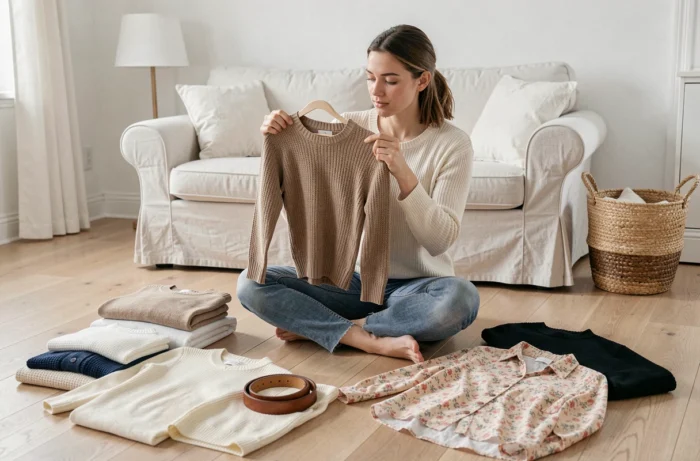
In thrift stores, the sorting has already been done by the brand. Items in too poor condition are removed before being put on the shelves, which reduces the risk but also limits good deals on high-end items. The main advantage remains the immediate fitting, which eliminates size errors.
On online platforms, the volume of available items is incomparably larger. The trade-off: the evaluation relies entirely on photos and descriptions. Vintage pieces or sought-after brands can sometimes reach prices close to new, driven by demand. We recommend systematically comparing the displayed price with that of the same item on multiple platforms to identify overvaluations.
Garage sales remain the realm of direct negotiation. The starting price is often low, and there is real room for discussion, but the search time is high and the quality very variable. Vintage style sometimes finds its best pieces there, provided you arrive early and feel each item.
Buying second-hand only reduces impact if it replaces a new purchase
Refashion emphasizes: the environmental benefit of reuse relies on substituting a new purchase. If the second-hand item adds to an unchanged volume of purchases, the expected ecological gain disappears. Before each purchase, the question to ask is simple: will this item replace an equivalent that you would have bought new, and will it be worn regularly?
A survey reported by Sud Ouest indicates that clothes resold online have often been worn little and have only completed part of their potential lifespan. Second-hand extends this lifespan only if the next buyer actually wears the item.
Choosing second-hand clothes methodically means first reading a label, inspecting the right areas, and knowing your rights according to the seller. The rest is patient sorting and a few reflexes that can be quickly acquired.