
A T1 and a T1 bis share the same administrative classification: a single main room. The difference between these two types of housing lies in the interior layout, not in the number of declared rooms. This discrepancy between the official nomenclature and the actual use of the housing has direct consequences on the rent, usable area, and regulatory constraints to check before signing a lease.
T1 and T1 bis: comparative table of key characteristics
| Criterion | T1 | T1 bis |
|---|---|---|
| Main room | One single room (living area and sleeping area combined) | A main room with a defined sleeping area (nook, mezzanine, recess) |
| Kitchen | Separate from the living area | Separate or open depending on configurations |
| Usable living area | Generally smaller than that of the T1 bis | Significantly larger due to the additional space |
| Number of rooms in the administrative sense | 1 | 1 (the sleeping area is not counted as a room) |
| Rent level | Lower at equivalent location | Slightly higher, related to the gain in space and comfort |
| Typical profile | Student, single person on a tight budget | Single person or couple looking for a separate sleeping space |
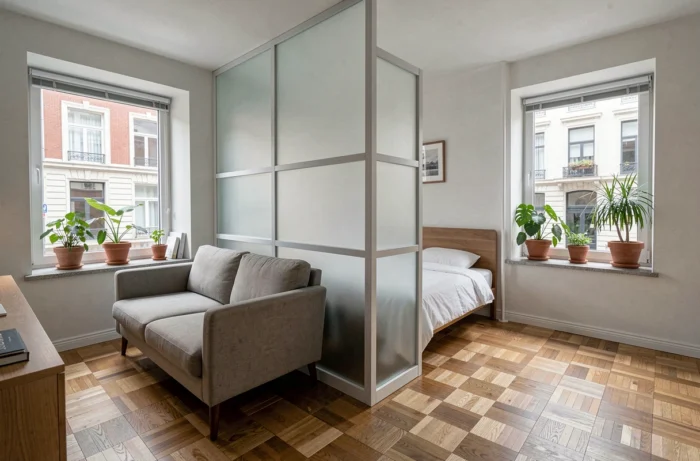
The central point: the T1 bis is not a T2. It does not have a closed bedroom with complete partitions. The sleeping area is visually separated from the living room (by a low wall, a half-level, or a nook), but it does not constitute an independent room in the sense of real estate classification. To understand the difference between a T1 and T1 bis apartment, one must look beyond the simple administrative label.
Decency constraints and DPE: what the budget must include
Before estimating a rent or purchase price, it is essential to check that the housing meets the current decency criteria. This point is often overlooked in T1/T1 bis comparisons, even though it conditions the legality of the rental.
Minimum area and habitable volume
To be legally rentable, a T1 or T1 bis must have at least 9 m² of habitable area with a ceiling height of 2.20 m, or a minimum volume of 20 m³. These thresholds apply to the main room. A mezzanine with a height below 2.20 m does not fully count in the calculation of the habitable area according to the Boutin law.
For a T1 bis with a nook or mezzanine, the verification is more complex than it seems. Requesting the Boutin measurement before any decision helps avoid unpleasant surprises.
Thermal sieves and rental bans
Small areas are the first to be affected by restrictions related to energy performance diagnosis. Since January 1, 2023, a property consuming more than 450 kWh/m²/year of final energy is prohibited from rental for new leases. Properties classified G in the DPE are subject to a ban starting in 2025, followed by F starting in 2028.
An old poorly insulated T1, typically a maid’s room under the roofs, often combines small area and poor energy performance. The heating cost per square meter is proportionally higher than in a larger property. For a landlord, the budget must anticipate the cost of renovation work (insulation, windows, heating system) or risk the property becoming unrentable.
Rent gap between T1 and T1 bis: the variables that weigh in
Since the T1 bis nomenclature has no strict legal definition, the rent gap varies significantly depending on local markets. Three factors explain most of the price difference.
- The actual area: a T1 bis generally offers a few more square meters than a standard T1, which directly affects the rent, especially in tight areas where the price per square meter is high.
- The perceived layout: a sleeping area visually separated from the living room increases the usable value of the housing. Tenants are willing to pay a higher rent for this separation, even if partial.
- The DPE and general condition: a renovated T1 bis with a good energy rating justifies a significantly higher rent than a classic energy-consuming T1. The gap widens as restrictions on thermal sieves tighten.
In tight areas (rent control), the rent reference per square meter does not always distinguish between T1 and T1 bis. A rent supplement can be applied if the housing has superior comfort characteristics, but this increase remains regulated and contestable by the tenant.

Choosing between T1 and T1 bis: the criteria to weigh according to your profile
The choice is not just a matter of monthly budget. It depends on the daily use of the housing and the expected duration of occupancy.
For a student in short-term rental (mobility lease from one to ten months), a well-located T1 near the campus or transport often remains the best compromise. The lower rent compensates for the lack of a night/day separation, especially since the time spent in the housing is limited.
For a teleworking person or a couple, the T1 bis changes the game. Having a sleeping area separate from the living room improves daily quality of life, especially when the housing also serves as an office. The difference in monthly rent, often a few dozen euros, is justified by significantly superior comfort for a long-term lease.
From an investment rental perspective, the T1 bis attracts a broader pool of tenants than a strict T1, which reduces vacancy periods. However, the acquisition cost and compliance with energy standards weigh more heavily on the profitability of a small area than a T2 or T3 type property.
The most discriminating criterion remains the energy compliance of the housing. A spacious T1 bis but classified F or G in the DPE will become unrentable in the short term. Checking the diagnosis before committing, whether in rental or purchase, is the factor that conditions all others.