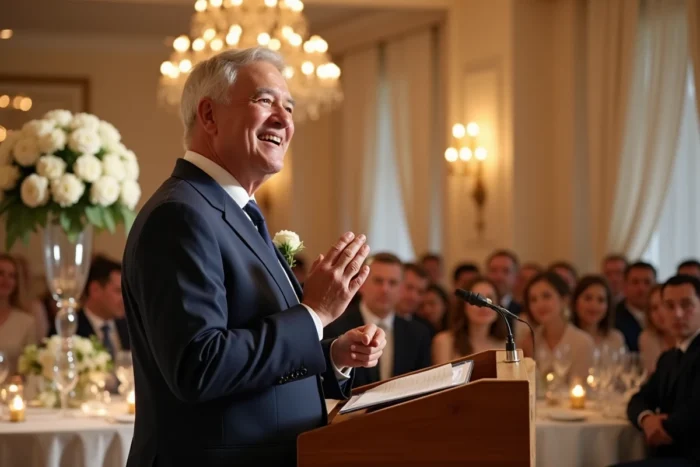
Your son is getting married, and you have been kindly (or firmly) entrusted with the task of giving a speech. The microphone, the room full of people, all eyes on you. The desire to make them laugh without hurting anyone, to move them without drowning the table in tears. This blend of humor and tenderness in a speech from the groom’s parents requires precise dosage, not an innate talent for comedy.
The three-minute rule: why duration changes everything in a wedding speech
Most guides talk about structure, tone, anecdotes. Very few address the factor that sabotages the most parent speeches: duration. A recent article from Le Figaro points out that monopolizing the floor for long minutes is one of the most criticized rudeness at weddings.
Why does this detail matter so much? Because humor gets tiring quickly. A joke that lands in the second minute becomes awkward by the eighth. Guests tune out, the couple smiles out of politeness, and the desired effect reverses.
Aim for three to four minutes of speaking time. This represents about one and a half pages in spaced writing. Preparing a humorous speech from the groom’s parents relies as much on conciseness as on word choice. Every sentence that does not bring laughter or emotion should be cut.
Time yourself out loud at least three times before the big day. Silent reading always gives a shorter duration than the actual delivery, especially when emotion slows the pace.
Finding the right anecdote: the mechanics of a successful joke
You probably have dozens of memories with your son. The trap is wanting to fit them all in. A funny speech relies on one or two strong anecdotes, not a catalog of cute moments.
What makes a wedding audience laugh
Wedding humor works through contrast. You recount a scene that guests can visualize, then connect it to the present with a slight twist. The comedy does not come from a formatted joke, but from the contrast between the child of yesterday and the adult of today.
For example, recalling that your son categorically refused to clean his room, then slipping in that you wish his partner good luck for the future works because the audience recognizes the situation. The anecdote is concrete, visual, and the punchline is gentle.
Topics to absolutely avoid
Le Figaro emphasizes that speeches that settle scores or humiliate under the guise of humor ruin entire receptions. A clear line separates affectionate teasing from disguised malice.
- The groom’s exes: even as a joke, mentioning past relationships makes everyone uncomfortable, especially the partner
- Family conflicts, even resolved: what is digested privately is not necessarily so in front of a hundred people
- Physical mockery or emphasized personal flaws: a light allusion is fine, insistence turns laughter into discomfort
Test each joke on someone who knows little about your son. If the person grimaces instead of smiling, that’s a reliable signal.
Alternating humor and emotion: the rhythm that holds an audience
A 100% funny speech leaves a superficial taste. A 100% emotional speech puts even the most resistant to sleep. The right balance resembles a wave: a rise of humor, then a softer dip, followed by a light resurgence.
Specifically, start with a funny anecdote that captures attention. Follow with two or three sincere sentences about what your son means to you. Then return to a humorous note before concluding with a word addressed to the couple.
The last sentence should be directed at the newlyweds, not the guests. This shift from the collective to the intimate provokes true emotion, the kind that cannot be forced.
The video option as a complement to the speech
A recent trend in Francophone weddings is to shorten the oral speech and accompany it with a humorous video montage projected during the meal. The Marryoke format (lip-sync music video) is part of these animations that combine well with a short speech from the parents.
The idea is not to replace the speech, but to lighten the oral narrative weight. You keep the microphone for the personal message, and the video takes care of childhood memories, embarrassing photos, and the montage that makes the whole room laugh.
Writing the speech together when both parents speak
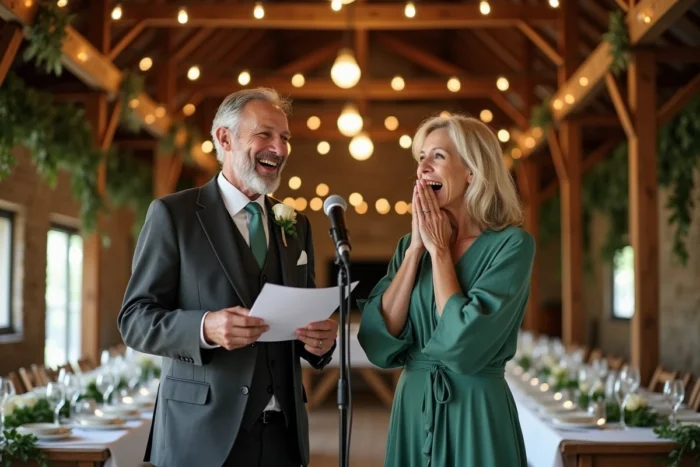
When both parents take the floor, the question of distribution arises. Reading a text in two voices can yield a touching result or a disjointed dialogue, depending on the preparation.
- Assign each anecdote to the parent who experienced it most closely: the mother recounts the kindergarten memory, the father the first bike ride
- Avoid cutting each other off intentionally for comedic effect: what seems natural in rehearsal often appears forced on the big day
- Plan a clear transition sentence between your two parts so that the flow does not resemble two speeches stuck together
The smoothest handover remains the simplest: one ends on a humorous note, the other picks up on a more composed tone. This contrast of registers between the two parents creates a natural rhythm without staging.
The groom’s parents’ speech does not need to be a stand-up routine or a tearful letter read in a trembling voice. A few minutes, a well-chosen anecdote, a moment of sincerity directed at the couple: this is what the guests remember, and what your son will cherish long after the celebration.