The proportion of women among motorcycle license holders is steadily increasing in France, but feedback from the field diverges on one point: traditional training does not always take into account specific morphological constraints. Size, weight of the machine, suitable equipment—each step on the path to motorcycle independence deserves special attention when you measure less than one meter sixty-five or weigh less than sixty kilograms.
Motorcycle Ergonomics: What Matters Beyond Seat Height
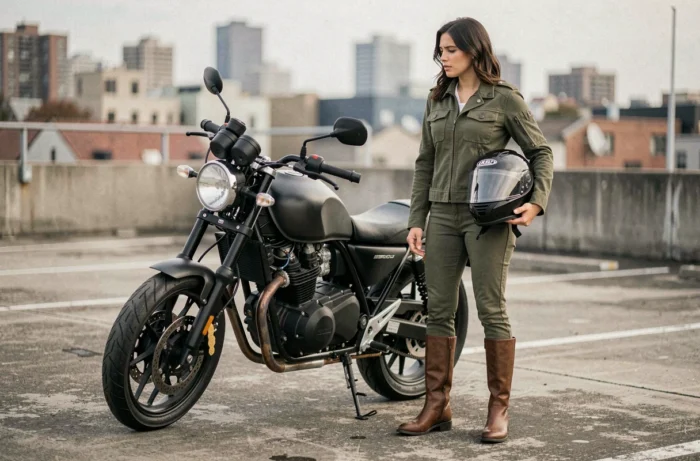
The technical specifications of a motorcycle display a seat height in millimeters. This figure is misleading, as it says nothing about the width of the seat or the shape of the tank at thigh level. A narrow seat allows for flat-footedness even on a machine whose seat height appears high on paper. Conversely, a wide seat on a low motorcycle can prevent proper ground contact.
The width of the seat and the position of the legs are as important as the height. Several specialized sources recommend not relying solely on manufacturer specifications and assessing the feel during slow maneuvers. Sitting on the motorcycle in the store is not enough: you need to reverse, make tight turns, and ride a few meters in full gear to judge the ease of handling.
The weight of the machine also plays a crucial role in confidence. A lightweight motorcycle forgives hesitations at a stop and trajectory errors at low speeds. For a beginner of small stature, prioritizing a motorcycle with a low center of gravity facilitates parking maneuvers and U-turns, where most falls occur. Resources dedicated to beginner female riders exist, particularly on https://www.missdeuxroues.fr/ which addresses these adaptation issues.
Motorcycle License and Driving School Training: Adapting the Course
The plateau test remains the dreaded hurdle for many candidates. The low-speed maneuverability exercises require a balance that directly depends on the ratio between the weight of the rider and that of the motorcycle. With less than fifty kilograms on a standard training machine, lifting the motorcycle after a fall or keeping it balanced during an emergency stop requires specific techniques.
Asking the instructor to adapt the progression is legitimate and often necessary. Some driving schools offer to start on lighter motorcycles or those with a lower seat height before moving on to the exam machine. The number of training hours varies significantly from one student to another.
The available data does not allow for defining a typical hourly volume, but feedback on specialized forums indicates that smaller candidates often take more track lessons before tackling road traffic.
Choosing a Suitable Driving School
Not all driving schools have motorcycles suitable for smaller riders. Before enrolling, checking the available fleet of machines and asking if the center offers additional plateau sessions saves time and builds confidence. An instructor experienced in training small-stature women knows the compensation techniques (supporting on one foot, hip position, clutch control during slow maneuvers) that are not included in the standard program.
- Check that the driving school has at least one motorcycle with a low seat or a lowering kit for plateau sessions
- Prefer a center that agrees to split the 125 cc training or A2 license into short sessions to avoid muscle fatigue
- Request a trial lesson before committing, to test the motorcycle and evaluate the instructor’s teaching style
Helmet and Women’s Gear: What the Standard Doesn’t Say
The preferred homologation standard in Europe is now ECE 22.06, which is gradually replacing the old standard. A certified helmet does not guarantee proper fit for every head shape. Skull shapes vary, and a helmet that squeezes the temples or has too much play at the jaw does not provide adequate protection in the event of an impact.
Trying on the helmet in-store for several minutes remains the only reliable method. Shaking your head, simulating a look over your shoulder, checking that the field of vision remains clear: these simple gestures reveal flaws that the size displayed on the label cannot anticipate.
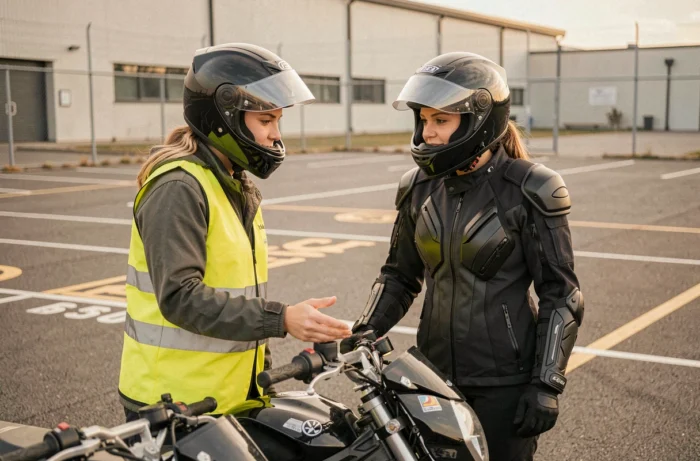
For the rest of the gear, women’s ranges have expanded in recent years. Cuts adapted to female morphology (narrower shoulders, shorter torso, wider hips) improve comfort and the effectiveness of protections. An overly large jacket allows back protectors and shoulder pads to slip out of place, reducing their effectiveness in the event of a fall.
- Choose certified gloves that actually fit the hand, not unisex measurements often calibrated to male hands
- Prefer boots with a sufficiently rigid sole to support the weight of the motorcycle at a standstill, while remaining flexible at the ankle for shifting
- Check that the motorcycle pants include adjustable knee and hip protections
First Kilometers in Traffic: A Gradual Progression
The temptation to jump directly onto busy roads exists, especially after obtaining the license. Field feedback converges on one point: initial practice in empty spaces followed by calm secondary roads builds confidence much more effectively than a sudden immersion in urban traffic.
Riding alone in an empty parking lot allows for practicing slow maneuvers without pressure. Gradual braking, tight U-turns, slaloming between ground markers: these exercises replicate plateau situations in a risk-free environment. Then moving on to less frequented roads, with wide turns and few intersections, gradually acclimates the eye to long-distance observation and traffic anticipation.
Managing the Fear of Falling
The fear of falling is rational and does not disappear with the license in hand. The majority of falls among beginners occur at a stop or at very low speeds, often because the supporting foot slips or the handlebars are turned too far. Always wearing full gear, even for a short trip, limits the consequences and reduces anxiety. Gear that makes you feel protected frees up attention for riding.
The approach of separating “women’s motorcycles” and “men’s motorcycles” is gradually losing ground in favor of a more practical logic: adapting the machine and training to the rider’s size, whatever it may be. The physical constraints associated with a small stature are not a hindrance, provided they are taken into account from the choice of driving school and the first motorcycle.