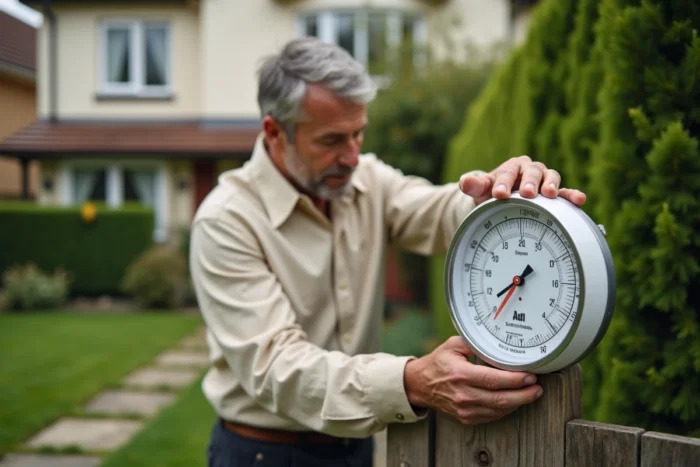
An outdoor thermometer fixed to the wall of the house, right next to the kitchen window: we’ve all seen this setup. The problem is that the facade radiates heat for hours after sunset, and the reading displayed no longer corresponds to the actual air temperature. To obtain a reliable measurement, the choice of location is as important as the quality of the sensor.
Facade Radiation: The Bias That No One Corrects
When a thermometer is fixed directly against an exterior wall, it measures a mix of air temperature and heat accumulated by the masonry. A wall exposed to the sun during the day continues to radiate long after nightfall. The result: nighttime readings are systematically skewed, sometimes by several degrees.
This phenomenon also affects sensors placed under a canopy or in a recess of the facade. Air circulation is poor there, and heat stagnates. We think we are reading the outside temperature, but we are actually reading an artificial microclimate created by the building itself.
To find the ideal location for placing an outdoor thermometer, the basic rule is to stay away from any built surface. We aim for at least one and a half meters of distance from the nearest wall, ideally more if the garden layout allows.
Height, Orientation, and Ground: Météo-France Criteria Applied at Home
Professional weather stations follow a precise protocol. We don’t need to replicate a reference station in our garden, but taking inspiration from it significantly improves the reliability of measurements.
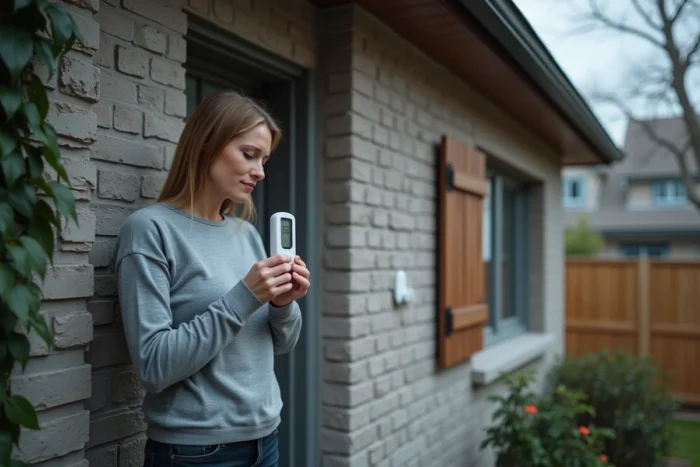
Météo-France recommends placing the probe between 1.25 m and 2 m above the ground, in permanent shade (north side in mainland France), and above a grassy surface. Grass prevents the re-radiation produced by concrete, gravel, or terrace tiles.
Three criteria to check before fixing the support:
- Permanently shaded all year round, including in summer when the sun is high. A shaded location in December can receive direct sunlight in June.
- Sufficient air circulation around the sensor. Avoid closed angles, dense hedges close to the thermometer, and roller shutter boxes that create heat pockets.
- A natural ground (lawn, soil) under the sensor rather than a slab or mineral covering. Grassy ground absorbs less heat and limits upward radiation.
The north orientation remains the safest choice for a distant support wall. If the thermometer is on a standalone pole in the middle of the garden, orientation matters less, as no facade disrupts the measurement.
Radiation Shield: Turning an Approximate Measurement into Usable Data
Even in the shade, an exposed sensor remains subject to infrared radiation reflected by the ground, fences, or neighboring buildings. Weather shelters (sometimes called radiation shields or “louvered bells”) solve this problem by protecting the probe while allowing air to circulate freely.
There are models made of perforated white plastic available for a few dozen euros. The white color reflects solar radiation instead of absorbing it, which prevents unwanted heating of the housing.
A often overlooked point: maintenance. Dust, cobwebs, and insects accumulate in the shelter’s slots over the months. This obstruction reduces natural ventilation around the sensor and causes a gradual drift in measurements. Seasonal cleaning of the shelter restores the reliability of readings without changing equipment.
Outdoor Thermometer on a Balcony or in a Co-Ownership: Adapting to Urban Constraints
In an apartment, there is neither a garden nor a free pole to plant in the lawn. The balcony often remains the only option, but it is also the worst configuration if precautions are not taken.
A south or west-facing balcony accumulates heat through re-radiation from the slab and the metal railing. The sensor should be positioned as far away from the facade as possible, fixed to the outer railing facing the street rather than the wall. Keeping the sensor away from any mineral surface remains the priority, even when space is measured in centimeters.
Opinions vary on this point, but fixing the sensor under the ledge of the upper balcony sometimes offers a good compromise: permanent shade, relative distance from the facade, and protection against direct rain. It is essential to ensure that air circulates well under this ledge and that the neighbor above has not installed an air conditioner whose outdoor unit blows hot air nearby.
Air Conditioners and Sources of Unwanted Heat
Outdoor air conditioning units expel a flow of hot air that can skew a thermometer located within several meters. One can also spot dryer vents, boiler flues, and exhaust fans. Any source of forced air constitutes a measurement bias even if it does not operate continuously.
Check the Consistency of Your Installation After a Few Days
Once the thermometer is set up, compare its readings with the temperature reported by the nearest Météo-France station. A consistent difference of one to two degrees is normal depending on altitude and immediate environment. A difference that varies significantly between day and night generally indicates a problem with stray radiation (too close a facade, mineral ground, absence of shelter).
Record the readings at fixed times for a week, morning and evening. If the difference with the reference station systematically increases at the end of the day, the thermometer is likely capturing heat radiated by a built surface. Moving the sensor a few dozen centimeters is sometimes enough to correct the issue.
A well-placed thermometer in a modest garden provides more consistent readings than a high-end model screwed against a south-facing wall. The sensor merely reflects what its immediate environment imposes on it.