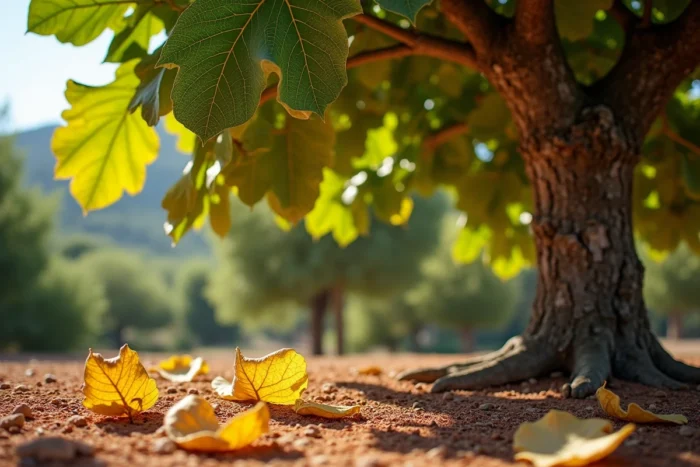
A fig tree planted for three years in decent soil, regularly watered, that loses its yellow leaves in the middle of summer for no apparent reason: this scenario recurs every year. The usual reflex is to water more or to add fertilizer. These two actions, applied at the wrong time, often worsen the situation.
When the yellowing is not related to a disease or a pest, the cause is almost always found in the soil or in water management.
Thermal stress of the fig tree during a heatwave: the underestimated cause
The fig tree tolerates dry heat well, but repeated peaks beyond 35-40 °C change the game. For the past few summers, nurserymen have noticed a marked increase in yellowing and leaf drop on otherwise healthy fig trees, in the absence of any pathology. The mechanism is simple: the tree sheds leaves to limit transpiration and preserve its water reserves.
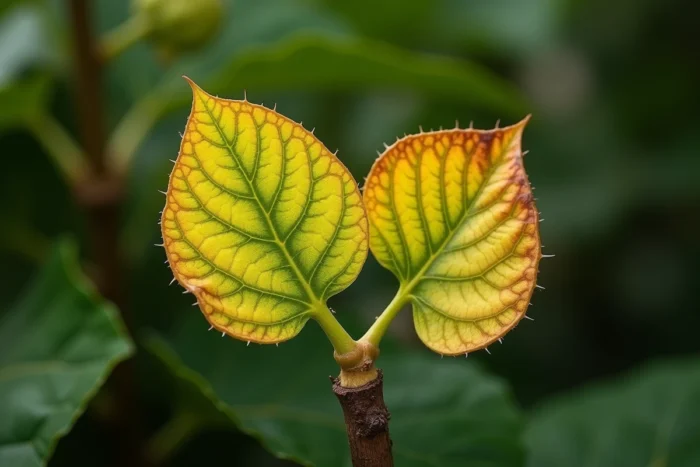
This thermal yellowing is often confused with a lack of water or a deficiency. The difference can be identified by examining the ground: the soil is not necessarily dry at depth, the leaves yellow uniformly, and the drop is rapid, sometimes within a few days. The fig tree leaves that yellow and fall under these conditions do not indicate deficiency or infection.
What we observe concretely at the foot of the tree
Scrape the soil about ten centimeters at the base of the fig tree. If the soil is still cool underneath, the problem is not watering. A surface-heated soil but moist at depth indicates pure thermal stress. In this case, a thick mulch protects the shallow roots much better than additional watering.
A mulch of straw, hay, or plant chips, maintained at a sufficient thickness around the trunk, lowers the soil temperature by several degrees. Avoid pine bark, which is too acidic for a fig tree that prefers neutral to slightly alkaline soil.
Watering the fig tree in summer: the trap of daily excess
Watering your fig tree every evening during a heatwave seems logical. In practice, it is one of the most destructive mistakes. Constantly waterlogged soil around the roots creates an asphyxiating environment. The roots cease to function, the foliage yellows, and this signal is interpreted as a need for additional water.
Recognizing excess water versus a lack
- Leaves yellowing from the bottom of the tree, with a soft and drooping appearance: likely excess water, especially if the soil remains sticky at depth
- Leaves drying at the edges then curling, starting from the top of the crown: lack of water, the fig tree can no longer supply the tips
- Uniform and rapid yellowing across the entire tree without spots or edge drying: thermal stress, often independent of watering
The fig tree in the ground, once well-rooted, does not need daily watering, even in high heat. A generous and spaced watering every seven to ten days encourages deep rooting. Light and frequent waterings keep the roots near the surface, where the soil heats up the most.
Fertilizing a stressed fig tree: the mistake that accelerates leaf drop
When the leaves yellow, we often think of a nitrogen or iron deficiency. The reflex to add fertilizer (chemical or organic) comes from good intentions. But on a fig tree whose roots are already suffering in dry or overheated soil, the addition of fertilizer worsens root stress and accelerates defoliation.
The reason is straightforward: a suffering root system no longer absorbs nutrients properly. The unabsorbed fertilizer increases the saline concentration around the roots, which exacerbates cellular dehydration. Recent feedback confirms that the most reliable recommendation remains to stop all nutrient inputs until normal conditions return (regular rains, lowered temperatures).
When to fertilize a fig tree without risk
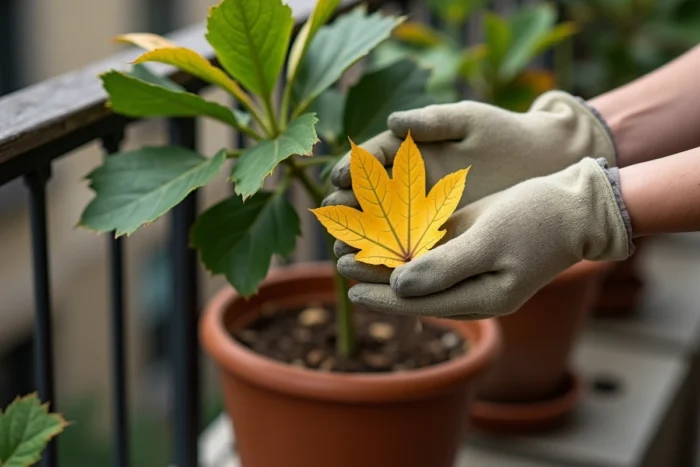
Compost or organic fertilizer applications are reserved for two periods: the end of winter (March-April), when vegetation restarts and the soil is still cool and moist, and possibly in early autumn after the first rains. In the middle of summer, we simply maintain the mulch and adjust watering.
Fungal diseases of the fig tree and leaf drop: distinguishing the real problem
Fig rust causes orange spots on the underside of the leaves, which eventually yellow and fall. Root rot, linked to persistent excess moisture, leads to a more general decline with branches gradually drying out. These two pathologies exist, but they are less common than water or thermal stress in well-maintained gardens.
- Rust: yellow-orange spots under the leaves, appearing rather at the end of summer in humid weather. Collect and destroy affected leaves, do not compost them
- Root rot: leaves yellowing with entire branches declining, earthy smell at the collar. Often irreversible if drainage is not corrected
- Fig tree black fly: visible damage on the fruits (larvae, eggs) rather than on the foliage, but a heavily attacked tree can weaken and lose leaves
Before treating, systematically check the state of the soil and the watering history. The majority of summer yellowings are not of fungal origin but related to water management or heat. An antifungal treatment applied to a simply stressed fig tree will not resolve anything and will delay the correct diagnosis.
Soil and drainage: the factor we forget at planting
A fig tree planted in compact clay soil, without drainage improvement at the time of planting, accumulates problems over the years. The roots stagnate in water in winter and cook in summer. If yellowing recurs every year despite appropriate watering, adding coarse sand or gravel on the surface, combined with a draining mulch, often improves the situation in the following seasons.
The fig tree that yellows in summer sends a signal that is misinterpreted in the vast majority of cases. Checking the soil before watering or fertilizing remains the most useful action. A tree left to manage its thermal defoliation without intervention generally recovers well as soon as temperatures drop.