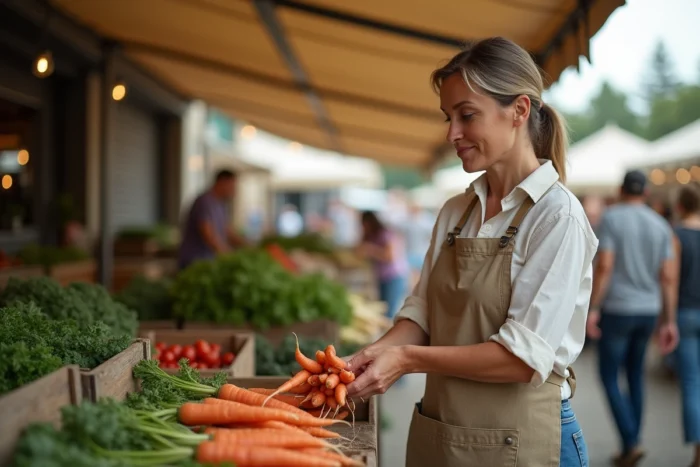
A food product can carry the AB label without being grown nearby, and a vegetable from the neighboring farmer may have been treated with synthetic pesticides. Organic and local refer to two distinct realities, sometimes complementary, sometimes contradictory. Understanding what each term encompasses allows for more coherent food choices, without artificially opposing these two approaches.
Organic versus local: what each term really guarantees
The AB label (Organic Agriculture) certifies a mode of production: absence of synthetic pesticides, no GMOs, crop rotation, regulated animal welfare. It says nothing about the distance traveled by the product.
A “local” product does not have a uniform regulatory definition. Depending on the distributors, it can refer to a radius of 30 to 150 kilometers. There are no constraints on the mode of cultivation attached to this term.
The frequent confusion between these two notions leads some consumers to believe that a local purchase is automatically healthier, or that an organic product is necessarily grown in France. Neither is guaranteed. Specialized platforms like lebioducoin.fr allow for cross-referencing the two criteria by identifying organic producers located near one’s home.
Organic and quality food labels: reading a label without making mistakes
With the multiplication of logos on packaging, distinguishing between official certification and marketing claims requires a minimum of reference points. Not all labels are equal, and some mentions have no regulatory value.
Controlled certifications
- AB and Eurofeuille: both logos attest to compliance with the European organic agriculture specifications, with annual inspections by an independent organization. The Eurofeuille is mandatory on all organic products sold in the European Union, while the French AB logo is optional but very widespread.
- The AOP (Protected Designation of Origin) and IGP (Protected Geographical Indication) labels guarantee a link to the terroir and know-how, but do not impose an organic production method. An AOP cheese can very well come from conventional farming.
- The HVE (High Environmental Value) label certifies practices that are more respectful of biodiversity and water management, without prohibiting synthetic pesticides. Its level of requirement remains below that of organic.
Non-certified mentions
The terms “natural,” “from the farm,” “authentic,” or “from the terroir” have no legal definition. Their presence on a package is purely marketing. Only the official pictogram, associated with the certification body’s number, provides a verifiable guarantee.
Seasonality of fruits and vegetables: the often underestimated lever
Buying organic and local loses some of its meaning if the products are grown in heated greenhouses in the middle of winter. Respecting seasonality reduces the carbon footprint much more than just the choice of label. An organic tomato produced in a heated greenhouse in January generates a significantly higher environmental impact than a conventional tomato grown in the open field in summer.
Seasonal fruits and vegetables also offer a nutritional advantage. Harvested at maturity, they contain more vitamins and minerals than products picked before they are ripe to withstand transport.
ADEME provides an interactive calendar of seasonal fruits and vegetables. This type of tool helps plan purchases without having to memorize the cycles of each variety. Fish and seafood also follow a seasonality, often ignored, which helps limit pressure on fish stocks.
The paradox of organic in France: rising consumption, declining surfaces
The consumption of organic products rose again in 2024 and 2025, after several years of decline. The Agency Bio confirmed this trend. However, organic agricultural land has decreased for the third consecutive year, and the number of farms engaged in organic farming is also declining.
This gap between supply and demand has a direct consequence on local circuits. When local organic production decreases, distributors compensate with imported organic products. The consumer who wants to combine organic and local finds themselves facing an increasingly restricted choice in certain regions.
This context makes the approach of actively seeking local producers engaged in organic farming even more relevant, rather than relying on the default offer in supermarkets.
Organic and local purchasing circuits: comparing concrete options
Several channels allow for cross-referencing organic and local criteria, each with its constraints.
- AMAPs (Associations for the Maintenance of Peasant Agriculture) offer a weekly basket of farm products, often organic, with a commitment for several months. The contents of the basket vary according to the harvest, which requires some flexibility in cooking.
- Farmers’ markets allow for direct contact and the opportunity to ask questions about cultivation practices. Not all exhibitors are necessarily producers: check for a sign indicating “farm producer” or the organic certification number.
- Specialized organic stores (cooperatives, dedicated brands) offer a wide selection but often mix local and imported products. Reading the origin mention on the label remains the only reliable reflex.
Collective catering is also evolving in this area. The legislative framework currently under examination in the Senate aims to strengthen transparency regarding the share of sustainable and organic products in public canteen purchases, with a publication obligation starting January 1, 2030.
Choosing food products with discernment does not require becoming a specialist in agroecology. Three reflexes are sufficient on a daily basis: check the certification logo, prioritize what is in season, and shorten the distance between the field and the plate when possible. The rest is marketing.