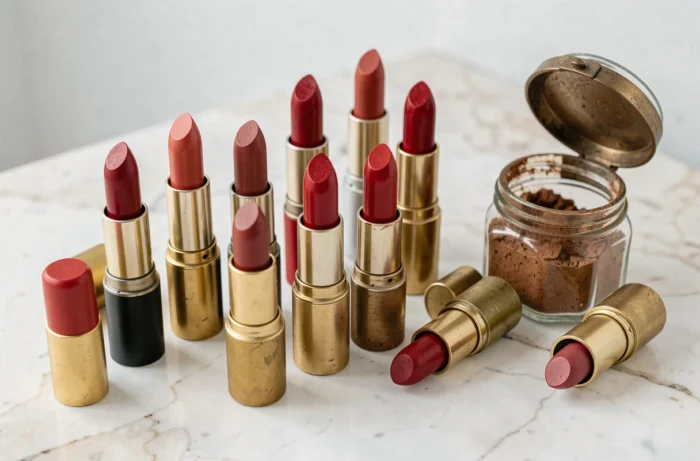
Whale fat in lipstick is one of the most persistent beliefs in cosmetics. However, the actual composition of current lipsticks has nothing to do with the formulations of the last century. Comparing what these products historically contained with what is found today allows us to measure the gap between myth and real ingredients.
Animal, vegetable, and synthetic waxes: a comparative table of lipstick ingredients
The base of a lipstick relies on a blend of waxes, oils, and pigments. What has changed is the nature of these waxes. Historically, spermaceti (a wax extracted from the sperm whale) provided a soft and stable texture. Since the ban on commercial whaling, this raw material has disappeared from industrial formulations.
To know what whale lipstick is made of has no connection anymore, we need to look at what has taken its place in the INCI lists.
| Type of wax | Common INCI name | Origin | Current status |
|---|---|---|---|
| Spermaceti | Cetaceum | Sperm whale | Banned since 1972 (Whaling Convention) |
| Beeswax | Cera alba | Animal (bee) | Still widely used, including in organic products |
| Candelilla wax | Candelilla cera | Vegetable (shrub) | Common vegan alternative |
| Carnauba wax | Copernicia cerifera cera | Vegetable (palm) | Widely used |
| Sunflower wax | Helianthus annuus seed wax | Vegetable | Expanding in vegan ranges |
| Synthetic wax | Synthetic wax | Synthetic | Present in recent conventional ranges |
The conclusion is clear: whale fat has not been included in any industrial formulation for over fifty years. Beeswax, on the other hand, remains a staple of current formulations, even in products labeled “natural” or “ethical”.
Beeswax in organic lipsticks: the real animal ingredient that no one questions
The public debate on animal ingredients in cosmetics focuses on whale fat or animal testing. Beeswax goes under the radar.
The INCI sheets of lipsticks marketed in 2025-2026, including those labeled organic or “clean”, show that cera alba is among the top ingredients in many formulas. An organic certified lipstick can contain beeswax as the main structuring component while presenting itself as an ethical product.
This discrepancy raises a question of consistency for consumers looking to avoid any animal-derived products. An “organic” label does not mean “vegan”. The distinction is rarely made clear on the packaging.
- A lipstick labeled “natural” or “organic” may contain beeswax, carmine (red pigment derived from cochineals), or lanolin (sheep wool fat)
- Only a certified vegan label (Vegan Society, PETA, Eve Vegan) guarantees the complete absence of animal-derived ingredients
- The term “cruelty-free” pertains to testing, not composition: a product not tested on animals may still contain beeswax
The real animal ingredient in current lipsticks is beeswax, not whale fat. Shifting the debate towards an ingredient banned for decades distracts from the animal components that are actually present.
INCI nomenclature and the origin of fats: how to read the composition of a lipstick
The INCI list (International Nomenclature of Cosmetic Ingredients) is the only reliable tool to check the composition of a cosmetic. Ingredients are listed in descending order of concentration.
To identify animal-derived fats and waxes in a lipstick, three INCI names frequently appear:
- Cera alba: beeswax, very common as a texturizing agent
- Lanolin / Lanolin alcohol: fat extracted from sheep wool, used for its emollient properties
- CI 75470 (carmine): red pigment obtained from crushed cochineals, responsible for certain intense shades
Conversely, terms like “synthetic wax,” “candelilla cera,” or “rice bran wax” indicate plant-based or synthetic alternatives. The difficulty lies in the fact that INCI names never specify whether the ingredient is “ethical” or not: they describe a chemical substance, not a process.
Allergens and substances under surveillance in lipsticks
Beyond the animal question, European regulations govern the presence of certain substances in cosmetics applied to the lips (leave-on products). Fragrance allergens are subject to recent regulatory tightening.
Studies have also highlighted the presence of metals (aluminum, cadmium, chromium, lead) in certain lipsticks and glosses. The detected concentrations remain low, but brands tend to reduce these traces under regulatory pressure. Reading the INCI list is not enough to detect these contaminants: they do not appear as intentional ingredients.
Vegan lipstick and formulation transition: where cosmetic brands stand
Since 2023-2024, several brands and distributors have communicated about abandoning animal waxes in favor of plant-based (sunflower, rice) or synthetic waxes. This transition concerns both conventional ranges and premium lines.
The shift does not always happen transparently. A reformulation may replace beeswax with sunflower wax without the packaging explicitly mentioning “no animal ingredient”. The lack of clear communication hinders readability for consumers.
The market is evolving under the combined effect of vegan demand, regulatory tightening on allergens, and increased attention to ingredient traceability. Whale fat, on the other hand, belongs to another century. The current issue revolves around beeswax, lanolin, and carmine, three animal ingredients still massively present, including in products that claim to be responsible.