
When a company manages its incidents via email, shared spreadsheets, or informal messaging channels, the resolution time depends less on the severity of the issue than on someone’s ability to find the right contact. Incident management in a business relies on a precise sequence: reporting, classification, escalation, resolution, and then review. Each missing link prolongs service interruption and multiplies the risks of recurrence.
Regulatory traceability and notification: what NIS2 changes for incident management
The European directive NIS2, applicable since October 18, 2024, imposes risk management measures, incident notification obligations, and an explicit role for the governing body in overseeing these processes on the affected companies. This framework no longer concerns only critical infrastructure operators: it extends to a much broader range of sectors and sizes of companies.
In Italy, the transposition of NIS2 has led to very operational requirements regarding response plans and notifications, with a regulatory update published in September 2025 and coming into effect in January 2026. This regulatory granularity illustrates an underlying trend: incident workflows must integrate traceability and managerial validation to remain compliant.
For French companies, this concretely means that an incident management tool must be able to timestamp each action, retain associated evidence, and generate an auditable history. A simple Excel spreadsheet does not meet any of these conditions. Specialized platforms like the one offered at irist.fr natively structure these obligations within their workflows, reducing the risk of non-compliance during an audit.
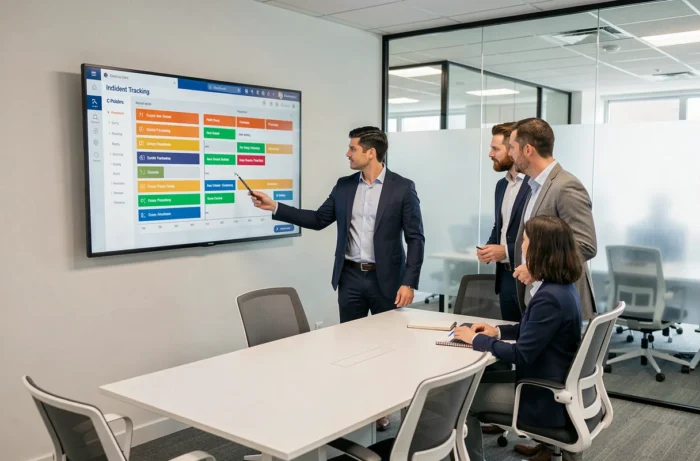
Incident management and incident response: two areas not to confuse
The market now clearly distinguishes between these two concepts. Incident response covers real-time action: detecting, containing, resolving. Incident management, on the other hand, encompasses a broader scope that includes intake, classification, escalation, monitoring, and post-incident review.
| Criterion | Incident Response | Incident Management (end-to-end) |
|---|---|---|
| Timeframe | Detection to resolution | Reporting to post-incident review |
| Main Actors | Technical teams (Ops, SRE, SOC) | Technical teams + management + QHSE |
| Primary Objective | Reduce downtime | Reduce recurrence and ensure compliance |
| Required Traceability | Technical logs | Complete history with hierarchical validation |
| Post-mortem | Optional depending on criticality | Systematic, with a corrective action plan |
Confusing the two often leads to choosing a pure alerting tool (like PagerDuty or Opsgenie) where the company needs a comprehensive ITSM platform covering the entire cycle. Conversely, a small business with rare and technical incidents does not need a complete QHSE workflow with three-level approval.
The common mistake: stacking tools without orchestration
A ticketing tool for IT, a form for workplace safety, a Slack channel for emergencies: this fragmentation creates blind spots. Minor incidents, too trivial to justify opening a formal ticket, go unnoticed. Yet it is precisely these repeated micro-malfunctions that ultimately lead to major interruptions.
Centralizing reporting in a single entry point reduces friction for employees. When reporting an issue takes less than thirty seconds on a smartphone, the reporting rate increases significantly, and the collected data becomes actionable for root cause analysis.
Automation of triage and orchestration by AI: the recent evolution of incident management software
Incident management tools have evolved beyond simple ticketing. The current trend focuses on operational AI applied to triage, coordination, and post-incident reporting. Recent platforms no longer just open a ticket: they automatically categorize the incident, identify the competent team, and trigger the appropriate escalation workflow.
This level of automation addresses a concrete problem. According to data from the competitive corpus, an average IT team spends about one-third of its time managing incidents and interruptions. Automating triage frees up a significant portion of this time for higher-value tasks.
Three capabilities differentiate current solutions from previous generations:
- Automatic classification through text analysis of the report, which assigns a priority and a domain (IT, security, maintenance) without human intervention.
- Orchestration of stakeholders with targeted notifications according to predefined rules, including on-call management and replacements.
- Assisted generation of the post-incident report, which synthesizes the timeline, actions taken, and recommendations from ticket data.

Criteria for choosing incident management software suitable for your company
The choice of a solution depends less on the number of displayed features than on its fit with the company’s actual process. An over-configured tool that no one uses costs more than a simple tool adopted by all.
- The ease of reporting for non-technicians: if the form takes more than two minutes, the reporting rate drops. Mobile access is a prerequisite, not a bonus.
- The coverage of the complete cycle: from reporting to post-incident review, including escalation and monitoring of corrective actions. A tool that stops at ticket closure leaves a blind spot on prevention.
- Integration with existing tools (messaging, HRIS, technical monitoring): every manual re-entry is a source of error and time loss.
- Native regulatory compliance: timestamping, audit trail, evidence retention. These functions must be integrated by default, not added as an overlay.
QHSE and IT: converging needs
QHSE (quality, hygiene, safety, environment) teams and IT teams share an identical need: to transform every incident into actionable data to reduce recurrence. The difference lies in the vocabulary and the frameworks. A good incident management software provides form templates tailored to each domain while feeding a common analysis framework.
The convergence between these two worlds is accelerated by the requirements of NIS2 and ISO standards. Companies that still manage their QHSE incidents on paper and their IT incidents on Jira lose the cross-sectional view necessary to identify systemic issues. A single incident repository improves the detection of shared root causes across domains, such as a maintenance defect that generates both a physical security incident and a connected equipment failure.