
What type of text resonates the most when you want to celebrate your aunt: a short quote, a rhymed poem, or a free prose message? The answer depends less on literary talent than on the specific bond that connects the author to their aunt. What differentiates a text read once from one reread years later often comes down to a detail: a shared memory, a two-person habit, a word that only this aunt uses.
Short quote, rhymed poem, or free prose: what each format allows
Before choosing your words, you need to choose your format. Each produces a different effect depending on the medium (card, SMS, engraved gift) and the occasion (birthday, celebration, spontaneous tribute).
| Format | Typical Length | Dominant Tone | Suitable Mediums | Main Limitation |
|---|---|---|---|---|
| Short quote | 1 to 3 sentences | Impactful, affectionate | SMS, engraving, photo frame | Little room for a personal memory |
| Rhymed poem | 4 to 12 lines | Tender, solemn | Card, reading aloud | Risk of forced rhymes that sound artificial |
| Free prose | 5 to 15 lines | Intimate, narrative | Letter, long message, album | Requires more writing effort |
The short quote works when the medium imposes a physical constraint. A phrase engraved on a piece of jewelry or a mug doesn’t exceed a few words. On the other hand, if the goal is to recount a specific memory, free prose offers a freedom that a rhymed poem may not always allow.
Those looking for beautiful quotes and poems for my aunt will notice that the most impactful texts share a common point: they name a lived moment, not an abstract feeling.

Poem for aunt: rhyme is not the criterion that makes one cry
A rhymed poem reassures its author, but the sincerity of the memory matters more than the perfection of the rhyme. A line like “Aunt, you smell like praline” brings a smile, and that’s already a lot. A line that recalls a specific Sunday, a failed recipe together, a car ride with a particular song, creates a different kind of emotion.
For a poem intended for your aunt to work, three concrete elements are enough:
- A shared sensory memory (a scent, a dish, a place) that grounds the text in reality rather than in the generic
- A habit or a typical phrase of the aunt, which only close ones will recognize
- A specific quality (her way of listening, her laugh, her manner of keeping a secret) rather than a catch-all adjective like “wonderful” or “great”
A four-line poem that contains these three elements will touch more than a twelve-line text filled with “love,” “always,” and “happiness.”
When free prose surpasses the poem
The prose format allows you to write as you speak. For an aunt with whom the relationship is filled with laughter and confidences, a text without rhymes but packed with shared references sounds more authentic. Prose also avoids the pitfall of a clumsy line that breaks the emotion instead of carrying it.
The choice between poem and prose also depends on the author’s age. A child writing “Aunt, I love it when you make me pancakes on Wednesdays” produces a more touching text than any copied sonnet. An adult, on the other hand, can afford the length of a letter that reflects on years of complicity.
Quotes and messages for chosen aunt: the chosen family has its own words
The notion of “aunt” goes far beyond the biological link. More than 30% of family networks in France include non-biological figures playing a significant educational and emotional role. These chosen aunts, close friends of the parents who have become pillars for the children, deserve texts that recognize the uniqueness of this bond.
A message for a chosen aunt cannot start with “the blood that unites us.” It is better to name what created the bond: a presence during a difficult moment, years of shared babysitting, a role as a confidante that the biological family has not always fulfilled.
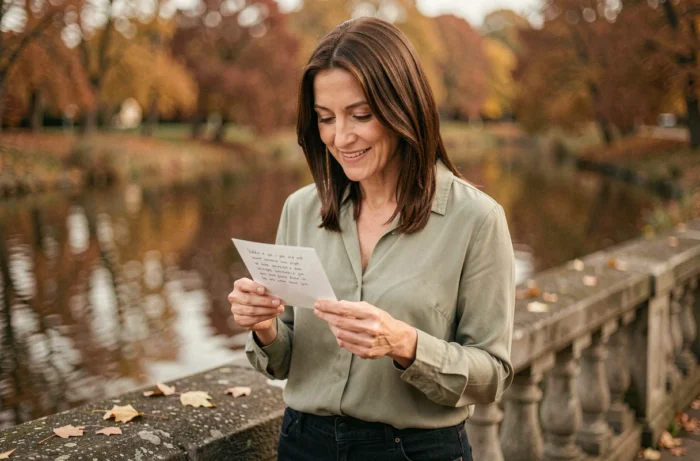
Formulations like “chosen aunt” or “aunt of the heart” are increasingly appearing in family rituals: small ceremonies, personalized cards, texts read during family gatherings. This vocabulary, still recent, gives emotional legitimacy to bonds that civil status does not recognize.
Adapting the tone to the occasion
A birthday calls for a warm and light tone. A tribute after a bereavement or family separation requires more gravity. The tone of the text should correspond to the moment, not to a general norm.
For a birthday, two to four lines with a memory and a wish are sufficient. For a letter of gratitude, ten to fifteen lines allow for elaboration on what the aunt has contributed. For an engraving on an object, a single impactful phrase does the job.
Common mistakes in texts for your aunt
The first mistake is copying a generic text found online without adding a single personal element. A text without a shared memory remains a text for any aunt, not for yours.
The second mistake concerns the tone. Comparing your aunt to a “second mom” can hurt if the relationship with the mother is complicated, or if the aunt claims a different role. It’s better to describe this unique role rather than reduce it to another.
The third mistake is overloading the text. A poem or message gains strength when it conveys one thing precisely rather than five things vaguely. A well-told memory is always better than an accumulation of flattering adjectives.
The text that will touch your aunt is the one where she will recognize herself without hesitation, because it speaks of her and not of an imaginary aunt. Whether it is three lines or fifteen, it is the precision of the memory that transforms words into emotion.