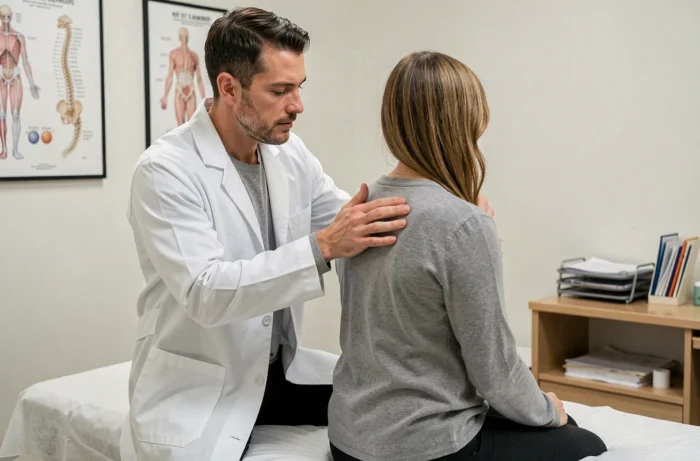
The osteotherapist addresses somatic dysfunctions through exclusive manual techniques. Understanding what an osteotherapist is requires distinguishing this practitioner from other health professionals who manipulate the body: their scope of action is limited to functional disorders, excluding organic pathologies that require medical, surgical, or pharmaceutical care.
RPPS Registration and Regulatory Framework of Osteopathy in France
Since October 2024, osteopaths are no longer registered in the ADELI directory but in the Shared Directory of Health Professionals (RPPS). This transition assigns a national number of eleven digits, retained throughout the career, even in the case of a change in the region of practice.
This migration has direct consequences on daily practice. The RPPS number is now the one that health insurance companies require for patient reimbursements and appears on invoices. The registration procedures with the ARS follow this new process.
From a fiscal perspective, the liberal activity falls under non-commercial profits (BNC). The services are exempt from VAT as they are provided by a practitioner authorized to use the title. The trade-off: no VAT recovery on professional purchases. The practitioner chooses between the micro-BNC regime and controlled declaration based on their turnover.
Technical Skills of the Osteotherapist: Beyond Palpation
The osteopathic diagnosis is based on a postural and palpatory evaluation that precedes any mobilization. A dedicated page allows for a better understanding of what an osteotherapist is and the precise contours of their practice. The quality of this initial assessment conditions the relevance of the treatment much more than the mastery of a specific technique.
Clinical Reasoning and Differential Diagnosis
The osteotherapist must identify the reasons for consultation that fall outside their scope of competence. A competent practitioner recognizes warning signals (red flags) that justify a referral to a physician. This ability to clinically triage distinguishes a trained professional from a technician applying protocols.
The reasoning does not stop at locating an area of restricted mobility. It integrates the patient’s history, their background, professional postural constraints, and lifestyle habits to construct a coherent functional hypothesis.
Structural and Functional Manual Techniques
The manual skills cover several complementary areas:
- Structural techniques (thrust) apply a high-velocity, low-amplitude impulse to a restricted joint, with precise control of the lever parameter
- Functional and myofascial techniques work towards tissue facilitation, adapted for patients for whom direct manipulations are contraindicated
- Visceral and cranial techniques mobilize structures through light and prolonged pressures, their effectiveness remaining debated in the literature
- The ability to adapt the gesture in real-time according to the patient’s tissue response, which requires several years of supervised clinical practice
Manual dexterity is acquired through clinical repetition, not solely through theory. Practical internships in consultation represent the foundation of technical training.
Osteopathy Training: Curriculum and Real Requirements
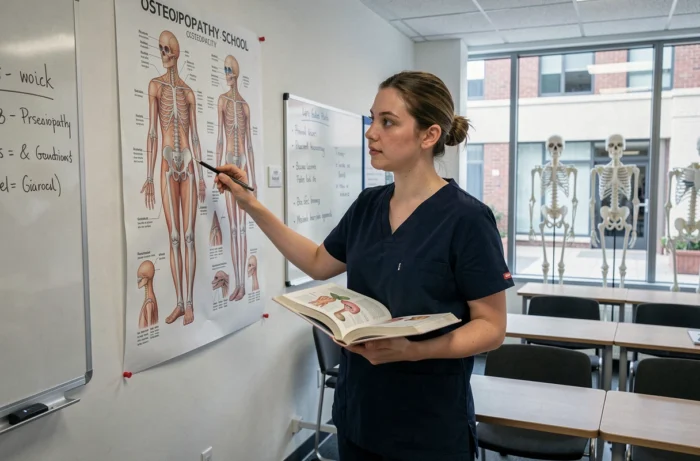
The osteopathy diploma corresponds to a bac + 5 level awarded by accredited institutions. The initial training spans five years and combines theoretical teachings in fundamental sciences, clinical semiology, and supervised practice in an internal clinic.
We recommend checking the accreditation of the institution with the Ministry of Health before any enrollment. Not all institutions have the same volume of clinical practice hours, which creates significant disparities among graduates.
Curriculum Content and Points of Caution
The first three years cover anatomy, physiology, biomechanics, and medical semiology. The last two years focus on clinical practice, osteopathic diagnosis, and comprehensive patient management.
A often overlooked point: the training does not prepare for managing a liberal practice. Accounting, communication, relationships with health insurance companies, and other health professionals fall under additional learning that the young graduate must acquire independently or through specialized short courses.
Practice Management and Economic Realities of the Profession
Liberal practice remains the predominant mode of establishment. The practitioner independently manages appointment scheduling, billing, relationships with complementary organizations, and the administrative follow-up of their activity.
The BNC regime imposes accounting rigor from the first year. The choice between micro-BNC and controlled declaration depends on the volume of activity, and the VAT exemption prohibits any deduction on equipment (consultation table, office equipment). This parameter heavily impacts the profitability of the first years of practice.
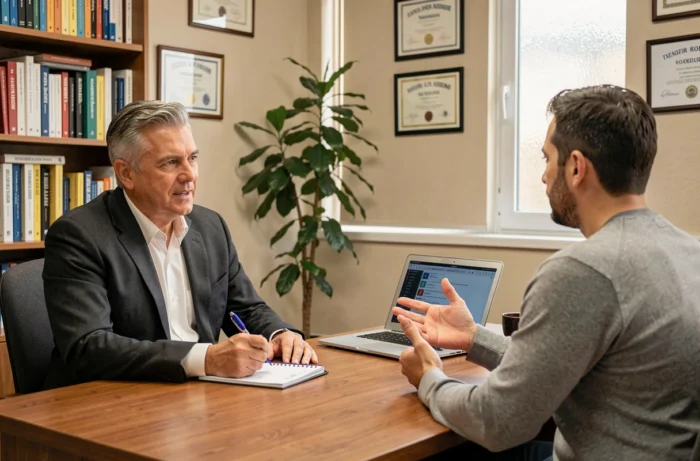
Collaboration with other health professionals (doctors, physiotherapists, podiatrists) constitutes a development lever. An osteotherapist who knows how to write a structured clinical report and communicate with the patient’s treating physician enhances their credibility and patient base through the interprofessional network.
The profession of osteotherapist requires a combination of manual skills refined through practice, rigorous clinical reasoning, and the ability to manage an independent activity. The transition to RPPS and the fiscal constraints specific to the liberal status remind us that mastering the technique is not enough: professional viability also relies on administrative and relational skills that initial training does not yet sufficiently integrate.